New Review of Girls Like Us: The Collection "Bulges with Debilitating Last Lines"
"The surprise-suplex-onto-concrete, knock-the-air-out-of-you kind of debilitating. Hazen is even dastardly enough to look the reader in the eye, then hook them with the very first last line: 'We’ve been called so many things that we are not, we startle at the sound of our own names.'"
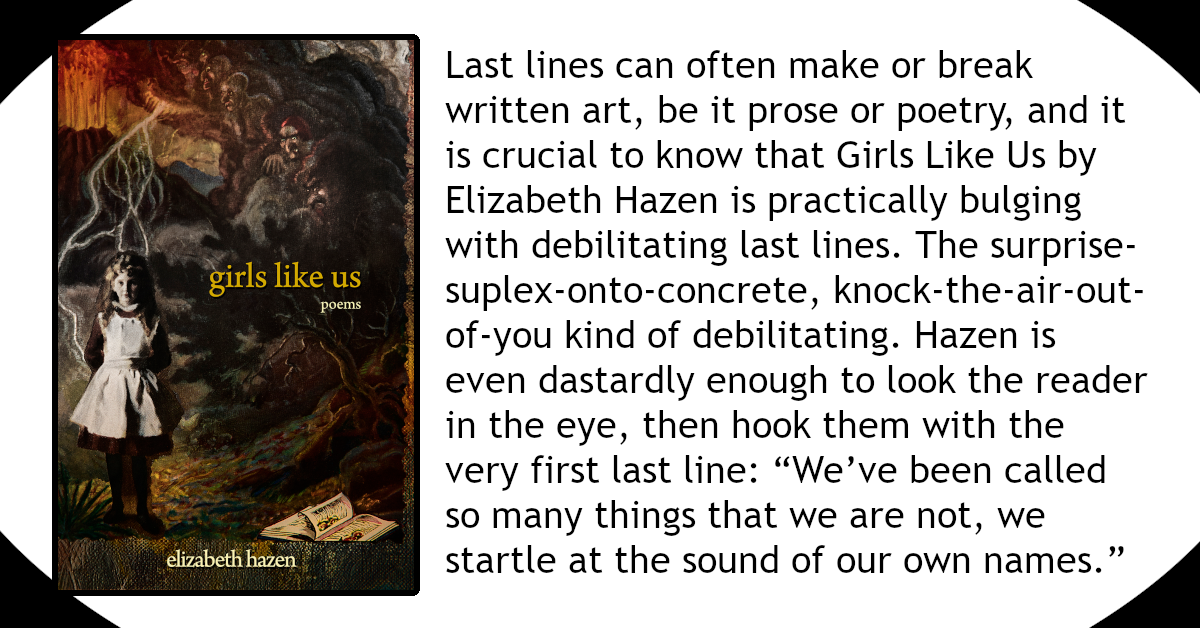
In Lannie Stabile's new review of Elizabeth Hazen's second collection Girls Like Us, she raves about the effect of Hazen's "last lines." Girls Like Us, she says, is "bulging with debilitating last lines." Like this one in the opening poem "Devices," that Stabile points to as like a "hook," “We’ve been called so many things that we are not, we startle at the sound of our own names.”
Stabile's review appears in The Poetry Question which seeks to lift the voices of small press poetry. Stabile is the Managing Editor at Barren Magazine and is a member of the MMPR Collective.
Girls Like Us is Hazen's second collection of poems after Chaos Theories (2016).

James J. Patterson Discusses his Favorite Early Feminists on episode 9 of LFTRR
In this episode of Live from the Reading Room, James J. Patterson discusses two of his favorite early feminist icons, Bertha Von Suttner and Adrienne Lecouvreur.

Rose Reads #9 Heralds the Good Works of SFWP
On this special episode of Rose Reads, Rose Solari discusses books from fellow small press, Santa Fe Writer’s Project, run by publisher, Andrew Gifford. Rose reads from two wonderful books, Wendy J. Fox’s If the Ice had Held and eightball by Elizabeth Geoghegan.

Episode 8 of LFTRR Explains the “First Page Test”
James J. Patterson is the reluctant scholar and on this episode of LFTRR he reads the from his essay of the same name. He also reads from books that have passed his “First Page Test” including “Night Train to Lisbon” by Pascal Mercier, “The Great Gatsby” by F. Scott Fitzgerald, “The Muse” by Jessie Burton, “The Tropic of Cancer” by Henry Miller, and “Confessions” by Jean-Jaques Rousseau.