New Review of Girls Like Us: The Collection "Bulges with Debilitating Last Lines"
"The surprise-suplex-onto-concrete, knock-the-air-out-of-you kind of debilitating. Hazen is even dastardly enough to look the reader in the eye, then hook them with the very first last line: 'We’ve been called so many things that we are not, we startle at the sound of our own names.'"
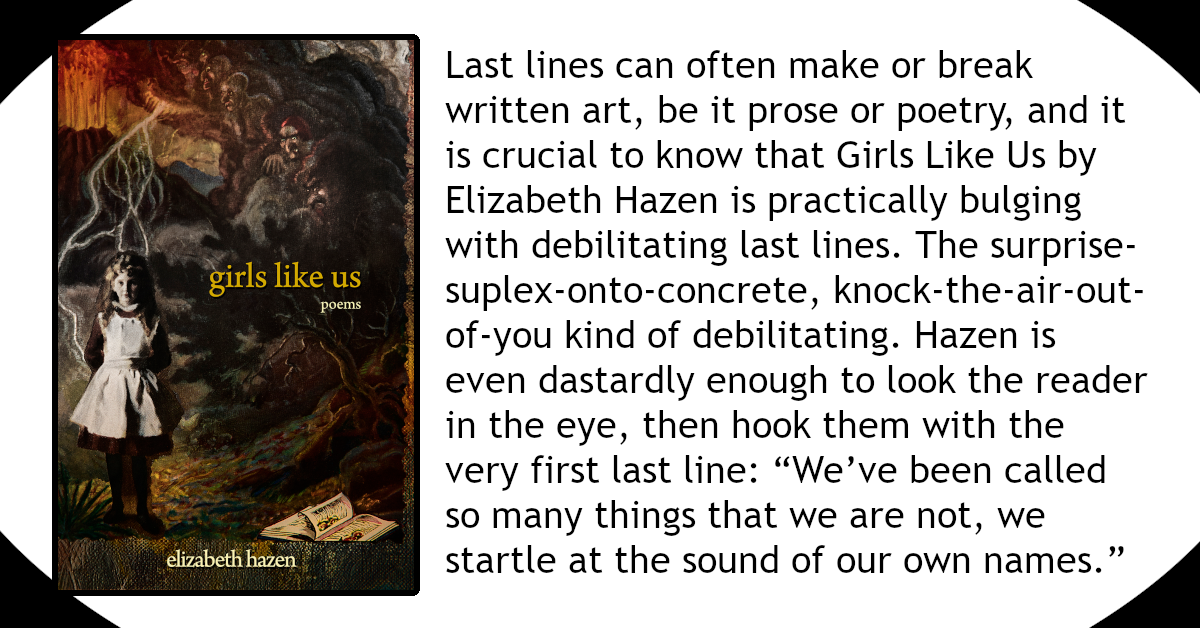
In Lannie Stabile's new review of Elizabeth Hazen's second collection Girls Like Us, she raves about the effect of Hazen's "last lines." Girls Like Us, she says, is "bulging with debilitating last lines." Like this one in the opening poem "Devices," that Stabile points to as like a "hook," “We’ve been called so many things that we are not, we startle at the sound of our own names.”
Stabile's review appears in The Poetry Question which seeks to lift the voices of small press poetry. Stabile is the Managing Editor at Barren Magazine and is a member of the MMPR Collective.
Girls Like Us is Hazen's second collection of poems after Chaos Theories (2016).

Talking Jazz and Rock with Poet Reuben Jackson (Laura Ritchie)
Author and music educator Lauren Ritchie sat down with ASP’s Reuben Jackson this week to talk jazz with the man himself. Reuben’s music credentials are long and impressive, from curating the Duke Ellington Collection at the Smithsonian to hosting a weekly Jazz radio show for NPR Vermont, to his poetry which takes inspiration from and frequently comments on the American Jazz idiom. Listen to or read the interview…
Rose Solari talks with Acclaimed Poet David Gewanter
This Sunday, October 21, at 8 p.m., ASP’s Rose Solari is reading with acclaimed poet, essayist, editor, and professor David Gewanter in a new poetry reading series at Second Story Books, 2000 P Street NW, Washington DC. In preparation for their reading, Rose talked with David about his work, particularly his most recent collection, Fort Necessity. Here is a part of their discussion…

Featured Audio: “Margaret in Oxford,” a Reading by Rose Solari
Robert Olen Butler loved Rose’s debut work of fiction for its sense of the eternity. This is one of many reasons why all of Rose Solari’s work must be treasured. It plays on life motifs, flips, forms, and languors upon the archetypes formed of human experience. We have spoken previously of Rose’s reverence for the myth in modern day. We even looked before at A Secret Woman’s sense of itself as being both poem and novel…