TLR Delivers a Stellar Review of GIRLS LIKE US
Michael Quinn of TLR traces the arc of Elizabeth Hazen's new collection "The Last Girl" and discovers the ways in which "Absence asserts permanence."
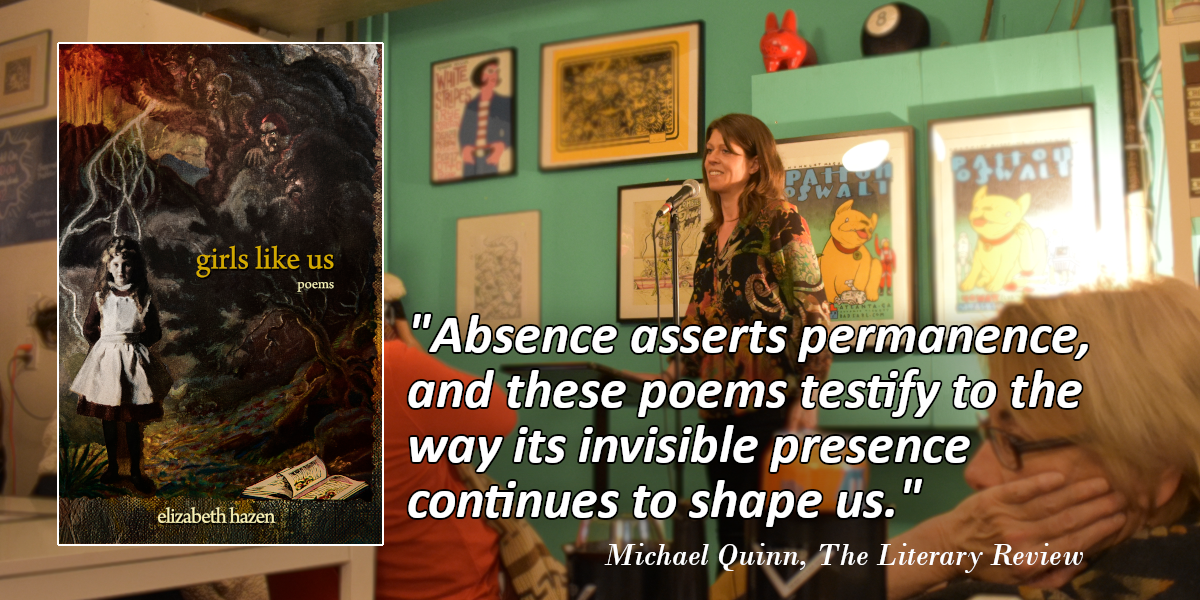
A new review this week from The Literary Review traces the arc of Elizabeth Hazen's Girls Like Us from a "[focus] primarily on the self, [to] poems [that] are gradually consumed by a responsibility to others, primarily through motherhood and its all-consuming need to provide for and protect."
Motherhood, womanhood, girlhood, addiction, and identity all present themselves in different ways throughout this arc, and Brooklyn-based reviewer Michael Quinn deals deftly with each of them, analyzing bits and pieces of many poems which tell the story of Girls Like Us rather than lingering too long on one or two images. In doing so, Quinn is able to depict Girls Like Us as a book that refuses pigeon-holing and which dares to be complicated and often difficult.
This dedication is evident in Quinn's description of the cover of the collection, a collage by Lindsay Fleming, "Near the girl’s feet, a book lies on the ground with its pages blown open. An adventure awaits: dangerous, scary, exciting, confusing." And, in a more detailed way, it is evident in Quinn's short but revealing analyses of the Hazen's Diagnosis cycle:
'“Diagnosis I,” “Diagnosis II,” and “Diagnosis III” respectively depict three scenes. In the first, an unwell woman is assured by her male doctor that despite her undiagnosed source of pain, there’s nothing wrong with her. In the second, a young virgin’s group of male tormentors becomes her booze-supplying seducers. In the third, the past of a woman at midlife is thrown into relief when a drunk aggressively hits on her. “Girls like / you, he repeated, leaving me / a blank to fill.”'

University of DC Jazz Forum: A Conversation with Reuben Jackson
In this video from the UDC Jazz Forum, jazz scholar, Reuben Jackson, sits down with historian, Rusty Hassan, to discuss his life and career.

Inside the Industry: The Wonderful World of Galleys
Joanna Biggar’s new book has just gone to galley, but what exactly does that mean?
Remembering W.S. Merwin: Grace Cavalieri’s Two Interviews with the Literary Giant
In 2000, the bicentennial of the Library of Congress, four Poets Laureate were appointed just for the occasion. The four dignitaries were W.S. Merwin, Robert Pinsky, Rita Dove, and Louise Gluck. I was to record one after the other for 4 hours. That first meeting with Merwin was unforgettable, as he arrived for an hour interview without so much as one poem in his hands. Fortunately, I had brought ten books for his signature and we puzzled our way through. He was delighted to recognize some of his first slim published volumes that were out of print, as well as a few collector’s items.