Former Student Describes Reuben Jackson’s Jazz-infused Poetry Class
“I’m going to play you some John Coltrane,” he said, his voice serious, soft-spoken. “Some people say Coltrane sounds like a bunch of salad,” he continued, “but it’s all in the way he mixes it.” He pressed “PLAY” and told us to write what came to mind.
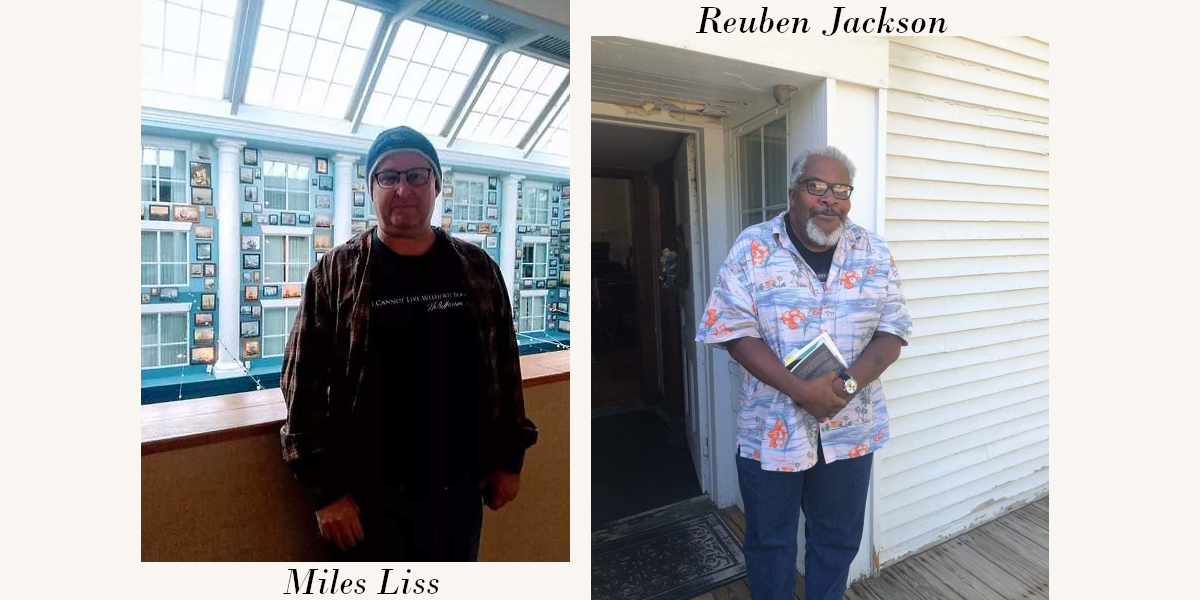
Miles Liss, who recently graduated with an MFA in poetry from Vermont College of Fine Arts, reflects on his time taking classes under maestro Reuben Jackson in this short essay. You can read the whole thing on Past-Ten here. Read Reuben's poetry here.
In the essay, Liss describes Reuben's unorthodox approach to teaching poetry, specifically his focus on extemporaneous writing in a similar vein to the off-the-cuff soloing and improvisation of jazz musicians. Below is an excerpt:
“I’m going to play you some John Coltrane,” he said, his voice serious, soft-spoken. “Some people say Coltrane sounds like a bunch of salad,” he continued, “but it’s all in the way he mixes it.” He pressed “PLAY” and told us to write what came to mind. Like a silent Miles Davis exiting the stage to give his fellow musicians an opportunity for expression, our instructor left the room.
As Coltrane played, I pressed my pencil against notebook paper and started writing. The words came out in a rush, in rhythms I had already possessed. It felt natural, in a way fiction never did. There was no agonizing over characters, plot charts and index cards. It was pure emotion.
We went around the room, reading our poems. I had two short pieces, riffs on cityscapes, and though I was nervous, I read them aloud. When I looked up, he was watching me, deep in thought and leaning back in his chair. He said nothing. Weeks later, he’d verbalize his praise, but for the time being, the silence spoke. As Miles Davis knew so well, the real music was in the silence.
Featured Audio: “Letter from Sligo Creek” a poem by Rose Solari
Like the cover photo, the poems in Difficult Weather are timeless and—unlike the poems in many first books—extraordinarily mature. Although the narrative voice is generally that of a young woman in her late twenties and early thirties whose subject matter sometimes ranges back to early childhood, these are poems of adulthood: the discovery and endlessly painful rediscovery of human frailty, sexual and emotional betrayal, bad love in all its familial and romantic varieties, memory, and elegy…
Listen to Grace Cavalieri Interview fmr. Poet Laureate Robert Pinsky
Grace Cavalieri is known widely for her stirring and empathic poetry, collected in her Legacy work Other Voices, Other Lives, but did you know that she is also an impressive interviewer? On her NPR show, The Poet and The Poem, she interviews significant poets from the US and around the world, with an aim of interpreting their lives through their poetry. In her tenure on the program, she has interviewed 9 US Poets Laureate (you can find a list with these archived interviews HERE), including the incomparable Robert Pinsky.

Featured Poetry: “Toytown” by Grace Cavalieri
The name Other Voices, Other Lives, is not purely poetical, in fact, for Grace Cavalieri it is a mission statement. In her Legacy Book of the same name there are several sections in 3rd person omnipotent which aim to breathe the same air as famous women who have suffered adversity. Tragic figure Anna Nicole Smith, feminist writer Mary Wollstonecraft, Cora from William Carlos William’s Kora in Hell. All in all they are an admix of Grace Cavalieri’s poetic life, all brought together in one beautiful volume; so, perhaps, we might figure that Anna Nicole Smith converses with Mary Wollstonecraft for the very first time in the pages of Other Voices, Other Lives.
Today, from the Anna section we have the heart-rending “Toytown”