Grace Cavalieri Explores “The Exquisite Singularity of Louise Glück” in new Essay
Grace Cavalieri celebrates the life and work of the Nobel Prize winner in this new essay published by The Washington Independent Review of Books
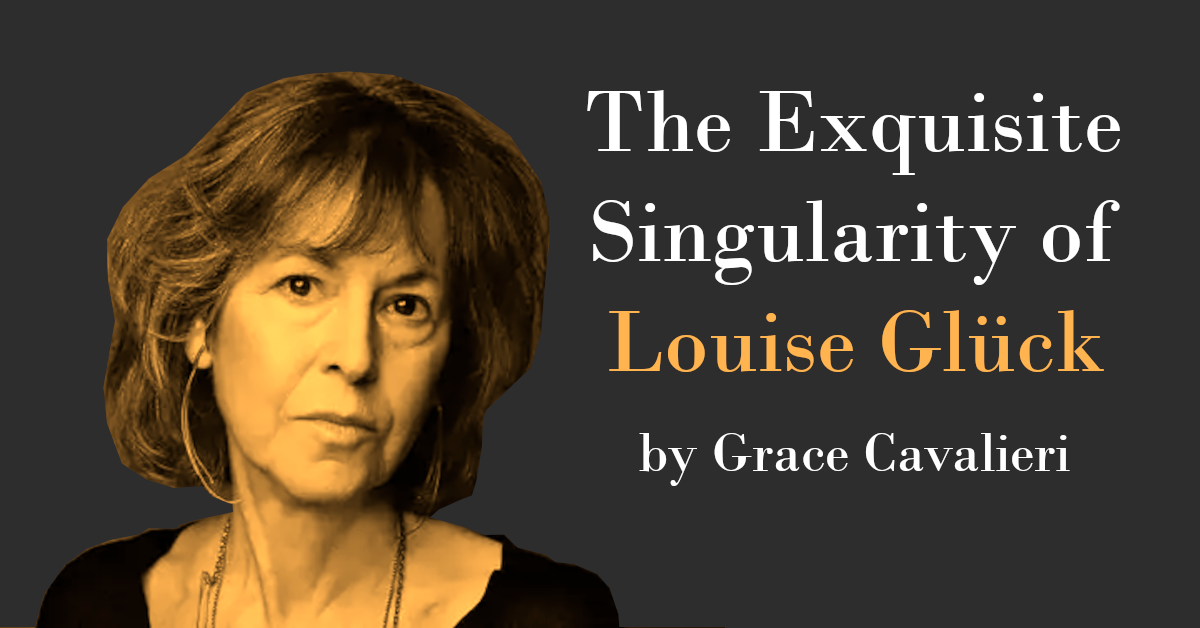
Grace Cavalieri's newest essay from the Washington Independent Review of Books explores the enigmatic poet, former Poet Laureate, and recent Nobel Prize winner, Louise Glück.
Like so many other Poets Laureate, Glück appeared on Grace's podcast, The Poet and the Poem. You can read a transcript of that interview HERE.
An excerpt of Grace's essay is below. Read the full thing over on WIRoB's website. And make sure you pick up Other Voices, Other Lives from the ASP store. OVOL includes poetry, prose, and transcribed interviews with Poets Laureate from throughout Grace's long career in letters.
From 2003-2004, Louise Glück, winner of most major poetry awards, was poet laureate of the United States. Now, in another step forward for womankind, she becomes the 16th woman to win the Nobel Prize in Literature.
Yet Glück is not emblematic or representational of other women, nor other poets. She’s too distinct, diamond-cut, inimitable, and proves that what is written deeply in spirit can become the clarion voice for our time.
And, in fact, the Nobel Committee cites this, “the individual made universal,” in her award, proving what most poetry readers already knew: that Glück is the most sustained voice of our generation.
What is it about her writing, then? What is it to be fully human in language?
She memorializes loss, isolation, rejection in language never quite heard before. If we want to know the size and shape of human heartbreak, we read Glück. She uses ancient myths to write modern narratives — featuring symbolic figures like Joan of Arc, Gretel, and Ulysses — through which to speak of marriage, divorce, childhood, motherhood.
If ever proof were needed that art redeems, transcends, and saves, it is the voice of Louise Glück.
On despair, she said, “I only wished for what I always wish for. Another poem.” We could teach a course in philosophy using her lines. For instance, “Why love what you will lose. There is nothing else to love.”
ASP Author’s Gift Guide for Book Lovers (PART 2)
Gift guide part 2 features Mysteries, Travel Writing, and Books about Northern California.
ASP Authors’ Gift Guide for Book Lovers
Well, it’s that time of year again, when holiday gift lists are popping up all over. Here at ASP HQ, we’re particularly interested, of course, in gifts for book-lovers, and we’ve noticed a curious fact: No matter how diverse the sources of these lists, a few titles pop up again and again. Usually these are recently published, widely reviewed best-sellers. While there’s nothing necessarily wrong with that, gift-givers might find themselves putting one more copy of the current hot mystery, or history, or memoir under a book-loving friend’s tree.
Featured Poetry: “Burial at Shanidar” by Elizabeth Hazen
This is no modern tradition, says Elizabeth Hazen. It is not only now that humans ornament their dead with flowers. “See,” she says in her rumination on tradition and humanity, Burial at Shanidar, “Even from a distance we dream of gardens where there should be stone.” And on Christmas especially, it is so wonderful to curl up with a book of poetry, even to read out-loud to one’s family, and bask in the ways we make words, just like the long winter days of dark, meaningful with light and tradition.