David Downie Interviewed by Author, Leslie Pietrzyk
David Downie discusses his new novel Red Riviera on Leslie Pietrzyk's "Work-in-Progress"
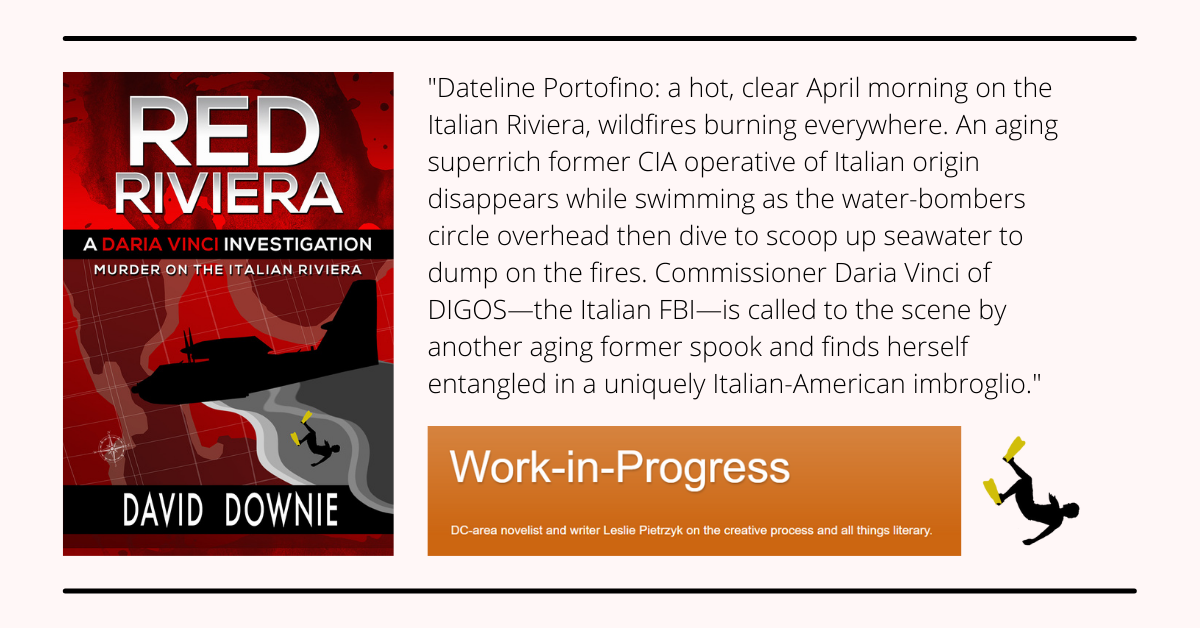
Renowned travel writer, David Downie, tackles the trials and tribulations of the crime novel with astounding acuity. Critics and peers agree, Red Riviera is "unforgettable" and "marvelous," and Downie's intrepid heroine, Daria Vinci, is a force to be reckoned with. In this new interview conducted by Leslie Pietrzyk, David Downie details the creation of Red Riviera and Daria Vinci, offers up some writing advice, and gives a recipe for Daria's favorite food, Classic Ligurian olive oil focaccia.
Read the entire interview here.
Excerpt below:
My favorite writing advice is “write until something surprises you.” What surprised you in the writing of this book?
Wow, so many things surprised me that I wouldn’t know where to start. Daria and the other characters in Red Riviera took shape as if conjured and then they ran wild. I had a hell of a time keeping them under control. It’s as if they were really alive and simply refused to obey the will of their creator.
Also surprising, I discovered that some of the things I had dreamed up and considered pretty outlandish were not only feasible but had actually occurred. Water-bombers do sometimes scoop up things—I won’t go into detail—other than water. Ancient Roman shipwrecks have been found exactly where I said one would be—a year or more after I’d finished writing the novel. The character I based the marquise on did in fact turn a hundred years old after I’d written the book and before its pub date.
How did you find the title of your book?
The title Red Riviera found me. I was on the Italian Riviera—that’s where I spend part of each year and have done since the 1980s. The sand blowing over the Mediterranean from North Africa in the sirocco wind was red. The hillsides were red from blazing wildfires. The flame-retardant chemicals being dropped by the Canadair water-bombers were red and left a red powdery stain on the landscape. The bougainvillea vines growing everywhere had red (or purple) blooms.
Lastly, red used to be the color of communism everywhere, right? Reds, pinkos? (That’s one reason I never understood the GOP’s adoption of the color, though I admit, I understand nothing about the GOP, most of all its continued existence). Italy had one of the world’s biggest communist parties and one of the strongholds of communism in the country was Genoa. Genoa is the capital of Liguria, the official name of the Italian Riviera. There has always been this juxtaposition of Genova la rossa—Red Genoa—and the black, fascistic, rich, glitzy Riviera spreading on either side of the big old industrial city. Then the politics shifted in the 2010s and the colors got muddled and everything started to look black and mottled and stained blood-red. At least, it did to me.

Small Press Week 2018: Monday, a look back at the Inception of ASP
We’d been talking about founding a press for a few years. I was becoming increasingly frustrated and angry about what was happening to some of the books I’d edited, and to some of my writer friends. Some of the books I worked on already had committed publishers, who knew my work and wanted me involved, and that’s great. But sometimes I was hired by a writer who had a publisher but knew they were not going to give the book a thorough edit – there is less and less of that going on these days, as you can see from opening even a big-name title. And I think — we think — that that is awful. If you are published by ASP, you get a thorough and very fine edit…
Featured Audio: “The Lovesick Lake,” a Story by James J Patterson
“Lovers of the personal essay should be rejoicing in the streets at word of this collection. For readers and acquaintances of Jimmy Patterson, it is long overdue, but the author was born in Washington, D.C., where the machinery of progress is congenitally slow. So this book, in many important ways – is what all satisfying collections of autobiographical essays should be – a mirror of place.” Rick Walter
Armistice Day, known in the US as Veteran’s Day, is now a work week past, but for James J Patterson it is a memory and idea that refuses to restrain itself to a 24 hour period. Yesterday we published his moving account of those veterans of The Great War he knew growing up, memorializing and contextualizing them for an audience whose experience of the war may only be through the muddy, pained faces in old photographs…
The World of Yesterday (Armistice Day, 2018)
My father always said that his first memory was of standing on the couch in his parent’s living room, small hands on the back cushion, peering out a picture widow at a neighborhood street in Bend, Oregon. There is a slow-moving line of cars and horse-drawn carriages inching its way down the lane. The line of cars is there every day, and every day he stands there and watches. His street is a long one and at the end of it is the cemetery. He is not allowed to go outside to play. Death is all anyone talks about. Death from a great flu epidemic. Death from a great war just ending. Everyone has lost someone. Most have lost a few. It is 1918…