Katherine E. Young Reviews Merwin's THE VIXEN for 25 Year Anniversary
25 years after it was originally published, Katherine E. Young looks back on one of Merwin's most underappreciated masterworks
Katherine E. Young's retrospective on W.S. Merwin's The Vixen appears in The Adroit Journal. Her newest collection of poetry is Woman Drinking Absinthe available from Alan Squire Publishing. An excerpt from her essay follows. Read the full review HERE.
Is there such a thing as too much good poetry? My uncle, who made a lifelong habit of sending me copies of each of W.S. Merwin’s books upon publication, thought so. “He writes too much,” my uncle would lament each year when the Nobel Prize for Literature, one of the few major prizes to elude Merwin during his long literary career, was awarded to some other writer. In a career as prolific as Merwin’s—more than fifty books of poetry, prose, and translation, including multiple literary masterpieces—it stands to reason that not every book can be a great one. Right?
Consider Merwin’s 1996 collection, The Vixen. Coming on the heels of Travels: Poems, winner of the 1993 Lenore Marshall Poetry Prize, The Vixen is in many ways a quiet book. While the poems in Travels are set all over the globe and vary considerably in form, length, and even appearance on the page, the sixty-four poems in The Vixen, most of them no longer than a page, follow a single form: a long line that starts at the left margin, followed by a second, indented line (which is sometimes enjambed and sometimes syntactically independent of the preceding line), mimicking the appearance of call-and-response on the printed page. (In his original review of the book for Boston Review, poet and critic Richard Howard called it “one poem in 64 sections.”) The look of the poems is neat, tight, controlled. “Quiet” and “controlled” are not synonymous with “lesser,” of course, and for anyone seeking poems that nourish and challenge, The Vixen offers a rich bounty.

Live from the Reading Room Episode 4 (THE HISTORIES)
In this edition of “Live From the Reading Room”, James J. Patterson reads from three histories, Will and Ariel Durrant’s “The Life of Greece,” Edward Gibbon’s “Decline and Fall of the Roman Empire”, and Leo Damrosch’s “The Club.”
He also reads “The Conjecture Chamber” from his first collection of essays BERMUDA SHORTS

New Review of Scattered Clouds Raves “SC is one I return to again and again”
Reuben jackson recieves another glowing review for his collection “Scattered Clouds.”
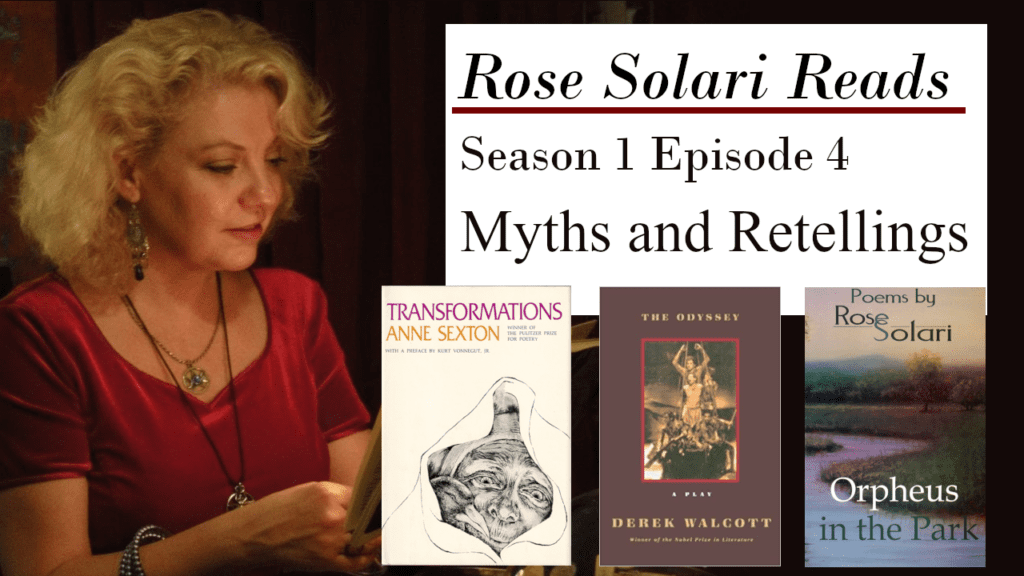
Rose Reads Episode 4 (Myths and Retellings)
In this episode of Rose Reads, poet Rose Solari talks re-telling poems – by Louise Gluck, Derek Walcott, Anne Sexton, and herself.