Katherine E. Young Reviews Merwin's THE VIXEN for 25 Year Anniversary
25 years after it was originally published, Katherine E. Young looks back on one of Merwin's most underappreciated masterworks
Katherine E. Young's retrospective on W.S. Merwin's The Vixen appears in The Adroit Journal. Her newest collection of poetry is Woman Drinking Absinthe available from Alan Squire Publishing. An excerpt from her essay follows. Read the full review HERE.
Is there such a thing as too much good poetry? My uncle, who made a lifelong habit of sending me copies of each of W.S. Merwin’s books upon publication, thought so. “He writes too much,” my uncle would lament each year when the Nobel Prize for Literature, one of the few major prizes to elude Merwin during his long literary career, was awarded to some other writer. In a career as prolific as Merwin’s—more than fifty books of poetry, prose, and translation, including multiple literary masterpieces—it stands to reason that not every book can be a great one. Right?
Consider Merwin’s 1996 collection, The Vixen. Coming on the heels of Travels: Poems, winner of the 1993 Lenore Marshall Poetry Prize, The Vixen is in many ways a quiet book. While the poems in Travels are set all over the globe and vary considerably in form, length, and even appearance on the page, the sixty-four poems in The Vixen, most of them no longer than a page, follow a single form: a long line that starts at the left margin, followed by a second, indented line (which is sometimes enjambed and sometimes syntactically independent of the preceding line), mimicking the appearance of call-and-response on the printed page. (In his original review of the book for Boston Review, poet and critic Richard Howard called it “one poem in 64 sections.”) The look of the poems is neat, tight, controlled. “Quiet” and “controlled” are not synonymous with “lesser,” of course, and for anyone seeking poems that nourish and challenge, The Vixen offers a rich bounty.
Fiddlin’ Around in Ireland
Nothing buoys the spirits like a walk along Grafton Street. Gray day or sunny, it’s bright with noise and laughter. Loud “hellos,” babies crying, neighborly gossip, rich brogues and lilting Irish airs float up onto the breeze. Our chosen course allowed for a stroll through St. Stephen’s Green. Sunlight dappled the leafy brakes. Inspired by the moment, Lawrence liberated his fiddle and sawed out a hornpipe. He was joined in his performance by a pair of amorous ducks.
On Grafton street we were immediately surrounded by music. A couple of 9 and 10-year-old boys, Donald Reagon and Paul O’Neill, were delighting passersby with smooth moves on the fiddle and concertina. College students with shaved heads played sitars. Old men played jazz. A guitarist somewhere was plucking out George Harrison tunes and singing, “Here comes the sun, little darlin’ here comes the sun.”
On that musical street there was only one poet—a threadbare character who, for a pound or a punt (Irish pound) or nothing at all, would recite a poem by a poet of one’s choosing. I selected Yeats and was honored with “The Fiddler of Dooney”:
“When I play on my fiddle in Dooney, Folk dance like a wave of the sea . . .”

An Interview with Elizabeth Hazen, Baltimore Poet and Baker Award Finalist
Baltimore poet, Elizabeth Hazen’s first collection of poems is entitled Chaos Theories. Last week the young poet was announced as a finalists for the prestigious Baker Artist Award in literature. We sat down to talk with her about her experience in Baltimore as an artist and what programs like The Baker Awards mean to artists.
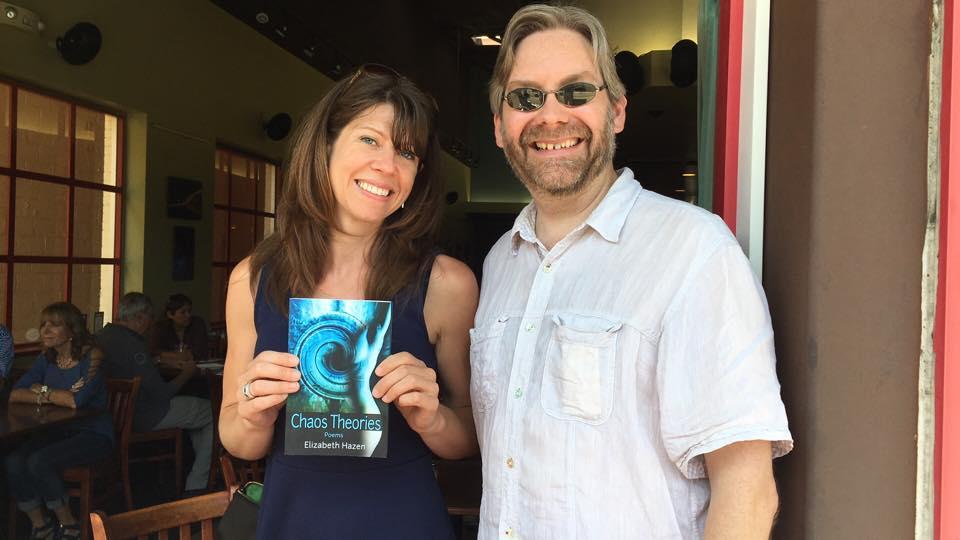
Elizabeth Hazen Announced as a Finalist for the 2019 Baker Award
This year, ASP’s own Elizabeth Hazen, author of the poetry collection Chaos Theories, is a finalist for the $10,000 literary honor. Hazen is a Baltimore resident and ardent supporter of the city’s burgeoning arts scene (named by Thrillist and Departures magazines as one of the best arts cities in America). She received her MFA from Johns Hopkins University and currently teaches English at the Calvert School in Baltimore.