Former Student Describes Reuben Jackson’s Jazz-infused Poetry Class
“I’m going to play you some John Coltrane,” he said, his voice serious, soft-spoken. “Some people say Coltrane sounds like a bunch of salad,” he continued, “but it’s all in the way he mixes it.” He pressed “PLAY” and told us to write what came to mind.
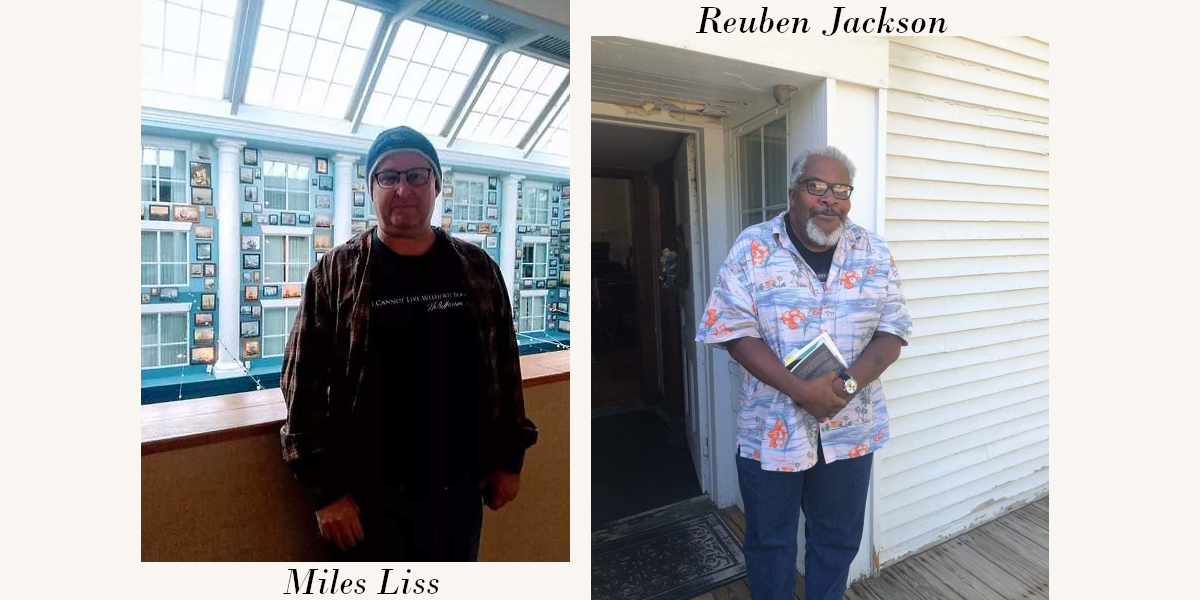
Miles Liss, who recently graduated with an MFA in poetry from Vermont College of Fine Arts, reflects on his time taking classes under maestro Reuben Jackson in this short essay. You can read the whole thing on Past-Ten here. Read Reuben's poetry here.
In the essay, Liss describes Reuben's unorthodox approach to teaching poetry, specifically his focus on extemporaneous writing in a similar vein to the off-the-cuff soloing and improvisation of jazz musicians. Below is an excerpt:
“I’m going to play you some John Coltrane,” he said, his voice serious, soft-spoken. “Some people say Coltrane sounds like a bunch of salad,” he continued, “but it’s all in the way he mixes it.” He pressed “PLAY” and told us to write what came to mind. Like a silent Miles Davis exiting the stage to give his fellow musicians an opportunity for expression, our instructor left the room.
As Coltrane played, I pressed my pencil against notebook paper and started writing. The words came out in a rush, in rhythms I had already possessed. It felt natural, in a way fiction never did. There was no agonizing over characters, plot charts and index cards. It was pure emotion.
We went around the room, reading our poems. I had two short pieces, riffs on cityscapes, and though I was nervous, I read them aloud. When I looked up, he was watching me, deep in thought and leaning back in his chair. He said nothing. Weeks later, he’d verbalize his praise, but for the time being, the silence spoke. As Miles Davis knew so well, the real music was in the silence.

University of DC Jazz Forum: A Conversation with Reuben Jackson
In this video from the UDC Jazz Forum, jazz scholar, Reuben Jackson, sits down with historian, Rusty Hassan, to discuss his life and career.

Inside the Industry: The Wonderful World of Galleys
Joanna Biggar’s new book has just gone to galley, but what exactly does that mean?
Remembering W.S. Merwin: Grace Cavalieri’s Two Interviews with the Literary Giant
In 2000, the bicentennial of the Library of Congress, four Poets Laureate were appointed just for the occasion. The four dignitaries were W.S. Merwin, Robert Pinsky, Rita Dove, and Louise Gluck. I was to record one after the other for 4 hours. That first meeting with Merwin was unforgettable, as he arrived for an hour interview without so much as one poem in his hands. Fortunately, I had brought ten books for his signature and we puzzled our way through. He was delighted to recognize some of his first slim published volumes that were out of print, as well as a few collector’s items.