Former Student Describes Reuben Jackson’s Jazz-infused Poetry Class
“I’m going to play you some John Coltrane,” he said, his voice serious, soft-spoken. “Some people say Coltrane sounds like a bunch of salad,” he continued, “but it’s all in the way he mixes it.” He pressed “PLAY” and told us to write what came to mind.
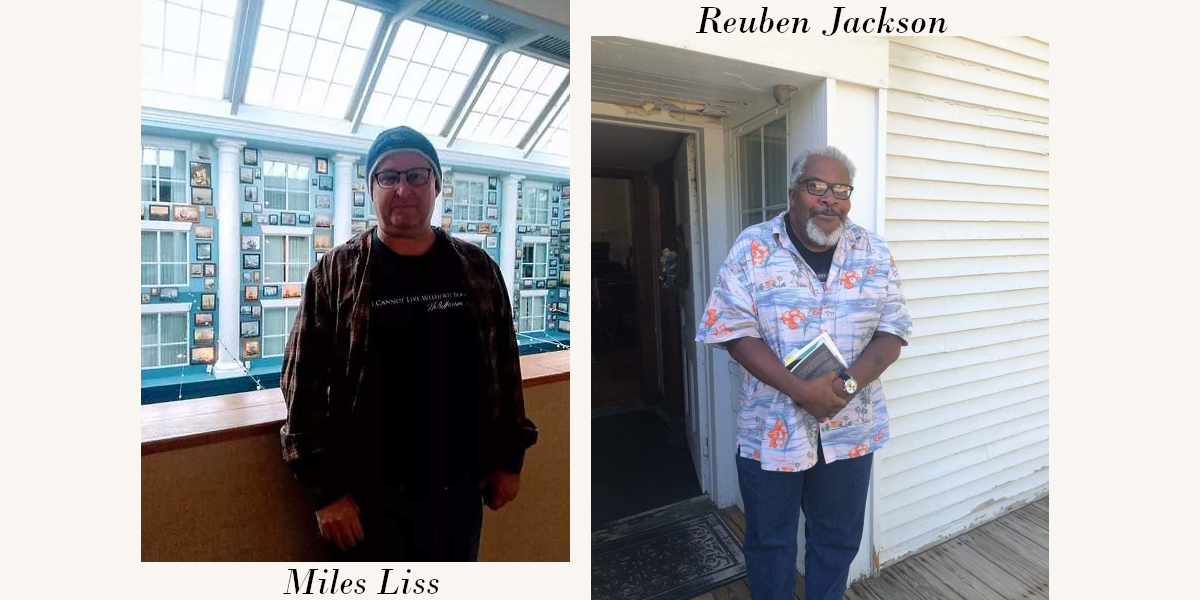
Miles Liss, who recently graduated with an MFA in poetry from Vermont College of Fine Arts, reflects on his time taking classes under maestro Reuben Jackson in this short essay. You can read the whole thing on Past-Ten here. Read Reuben's poetry here.
In the essay, Liss describes Reuben's unorthodox approach to teaching poetry, specifically his focus on extemporaneous writing in a similar vein to the off-the-cuff soloing and improvisation of jazz musicians. Below is an excerpt:
“I’m going to play you some John Coltrane,” he said, his voice serious, soft-spoken. “Some people say Coltrane sounds like a bunch of salad,” he continued, “but it’s all in the way he mixes it.” He pressed “PLAY” and told us to write what came to mind. Like a silent Miles Davis exiting the stage to give his fellow musicians an opportunity for expression, our instructor left the room.
As Coltrane played, I pressed my pencil against notebook paper and started writing. The words came out in a rush, in rhythms I had already possessed. It felt natural, in a way fiction never did. There was no agonizing over characters, plot charts and index cards. It was pure emotion.
We went around the room, reading our poems. I had two short pieces, riffs on cityscapes, and though I was nervous, I read them aloud. When I looked up, he was watching me, deep in thought and leaning back in his chair. He said nothing. Weeks later, he’d verbalize his praise, but for the time being, the silence spoke. As Miles Davis knew so well, the real music was in the silence.

Small Press Week 2018: Monday, a look back at the Inception of ASP
We’d been talking about founding a press for a few years. I was becoming increasingly frustrated and angry about what was happening to some of the books I’d edited, and to some of my writer friends. Some of the books I worked on already had committed publishers, who knew my work and wanted me involved, and that’s great. But sometimes I was hired by a writer who had a publisher but knew they were not going to give the book a thorough edit – there is less and less of that going on these days, as you can see from opening even a big-name title. And I think — we think — that that is awful. If you are published by ASP, you get a thorough and very fine edit…
Featured Audio: “The Lovesick Lake,” a Story by James J Patterson
“Lovers of the personal essay should be rejoicing in the streets at word of this collection. For readers and acquaintances of Jimmy Patterson, it is long overdue, but the author was born in Washington, D.C., where the machinery of progress is congenitally slow. So this book, in many important ways – is what all satisfying collections of autobiographical essays should be – a mirror of place.” Rick Walter
Armistice Day, known in the US as Veteran’s Day, is now a work week past, but for James J Patterson it is a memory and idea that refuses to restrain itself to a 24 hour period. Yesterday we published his moving account of those veterans of The Great War he knew growing up, memorializing and contextualizing them for an audience whose experience of the war may only be through the muddy, pained faces in old photographs…
The World of Yesterday (Armistice Day, 2018)
My father always said that his first memory was of standing on the couch in his parent’s living room, small hands on the back cushion, peering out a picture widow at a neighborhood street in Bend, Oregon. There is a slow-moving line of cars and horse-drawn carriages inching its way down the lane. The line of cars is there every day, and every day he stands there and watches. His street is a long one and at the end of it is the cemetery. He is not allowed to go outside to play. Death is all anyone talks about. Death from a great flu epidemic. Death from a great war just ending. Everyone has lost someone. Most have lost a few. It is 1918…